
Louisiana has become one of the most important areas to watch for carbon storage in the United States. It has the geology, the infrastructure, the federal investment, and now, as the third state to receive Class VI primacy from the EPA, the regulatory authority. But there is an unresolved tension in Louisiana. The state is moving fast to deploy carbon management, while the systems needed to support project deployment — public trust, community participation, and meaningful oversight — are still being built.
Republican Senator John Kennedy’s recent remarks provided a window into that tension, and notably, not from the angle you might expect. He is explicit that he is “not taking sides” on the technology and is “not here to debate the merits of carbon capture and sequestration.” His concern is different: how carbon storage is deployed and what rights communities and landowners should have throughout that process.
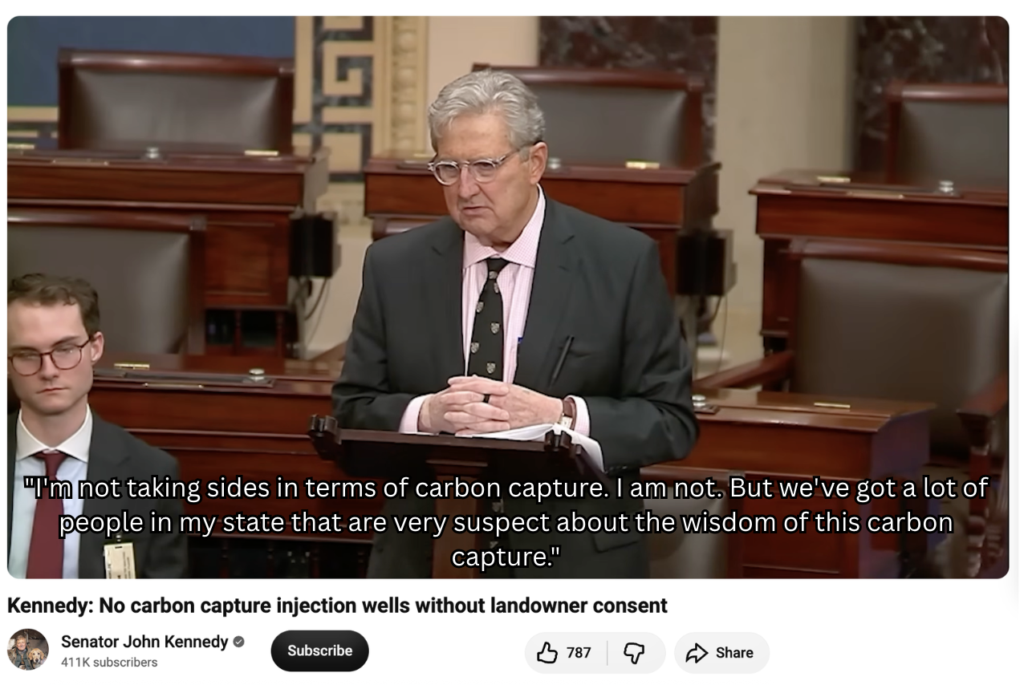
Those concerns — property rights, landowner consent, trust in government and private actors, corporate incentives created through the federal 45Q tax credit, and the use of eminent domain for privately developed storage projects — are fundamentally about agency. He argues that if a landowner wants to host a carbon storage project, that decision should be theirs to make. His thoughts are not simply whether carbon dioxide should be stored underground, but whether communities retain meaningful agency over decisions that affect their property and livelihoods.
The points he raises are remarkably similar to those I’ve heard from Tribal Nations, environmental justice organizations, rural landowners, and community-based organizations across the country. The language differs, but the underlying concerns are often the same with communities: transparency, accountability, meaningful participation, fair distribution of benefits and burdens, and confidence that commitments will be upheld over time.
Over the past year, the state has become a focal point for debates around Class VI permitting. Lawsuits, legislative battles, and community opposition have emerged alongside efforts to accelerate deployment. Taken together, these debates suggest that the next challenge for carbon storage is not simply deploying projects, but also about building public oversight, transparency, and accountability.
Class VI wells are the regulatory pathway for permanently storing carbon dioxide deep underground. Before a permit can be issued, developers must demonstrate that a storage site can safely contain carbon dioxide, protect underground sources of drinking water, monitor stored carbon over time, maintain financial responsibility, and provide for long-term stewardship. Historically, EPA reviewed and approved every Class VI permit. Under primacy, Louisiana now has the authority to review, issue, and oversee those permits itself. Considering the history of mistrust in government and policies that led to the creation of neighborhoods like “Cancer Alley”, primacy in Louisiana transfers more than permitting authority—it also transfers greater responsibility for ensuring that communities have confidence in the institutions overseeing deployment.
Too often, conversations about the speed and scale of carbon removal are viewed through a partisan lens or categorized as “equity and justice” issues. Yet these same themes emerge across communities I work with who have very different political identities and lived experiences. Whether the language is property rights or community agency, local control or public accountability, the underlying questions are always the same: who makes decisions, who captures the benefits, who assumes the risks, and whether institutions can be trusted to support public interests over time. This broader pattern has informed Carbon180’s development of the CORE framework.
Rather than treating equity and justice as issues separate from deployment, CORE approaches them as essential components of governance that shape whether projects are viewed as legitimate, whether communities are willing to participate, and ultimately whether carbon removal can scale in a way that is both technically successful and publicly durable. This approach has shaped many of CORE’s principles.As carbon removal continues to scale, I suspect we’ll see these same conversations emerge in more places across the country. The pathways and politics may vary, but communities will continue to push for the same principles of transparency, participation, and trust. This reinforced that equity and justice are less about politics than they are about sound governance. They provide a way of thinking about how decisions are made, how trust is built, and how carbon removal can scale both technically and with lasting public support.
Edited by Ana Little-Saña. Photo by Courtney Fee (Carbon180).