
As the carbon removal field continues to grow, so does the imperative to design safe, beneficial projects and programs that serve our communities, ecosystems, and climate. This need led us to create the Community-Informed, Open Access, Reviewed, and Evaluated (CORE) Framework — a living reference that addresses longstanding barriers to scaling just, equitable, and highly accountable carbon removal.
See our framework in action with
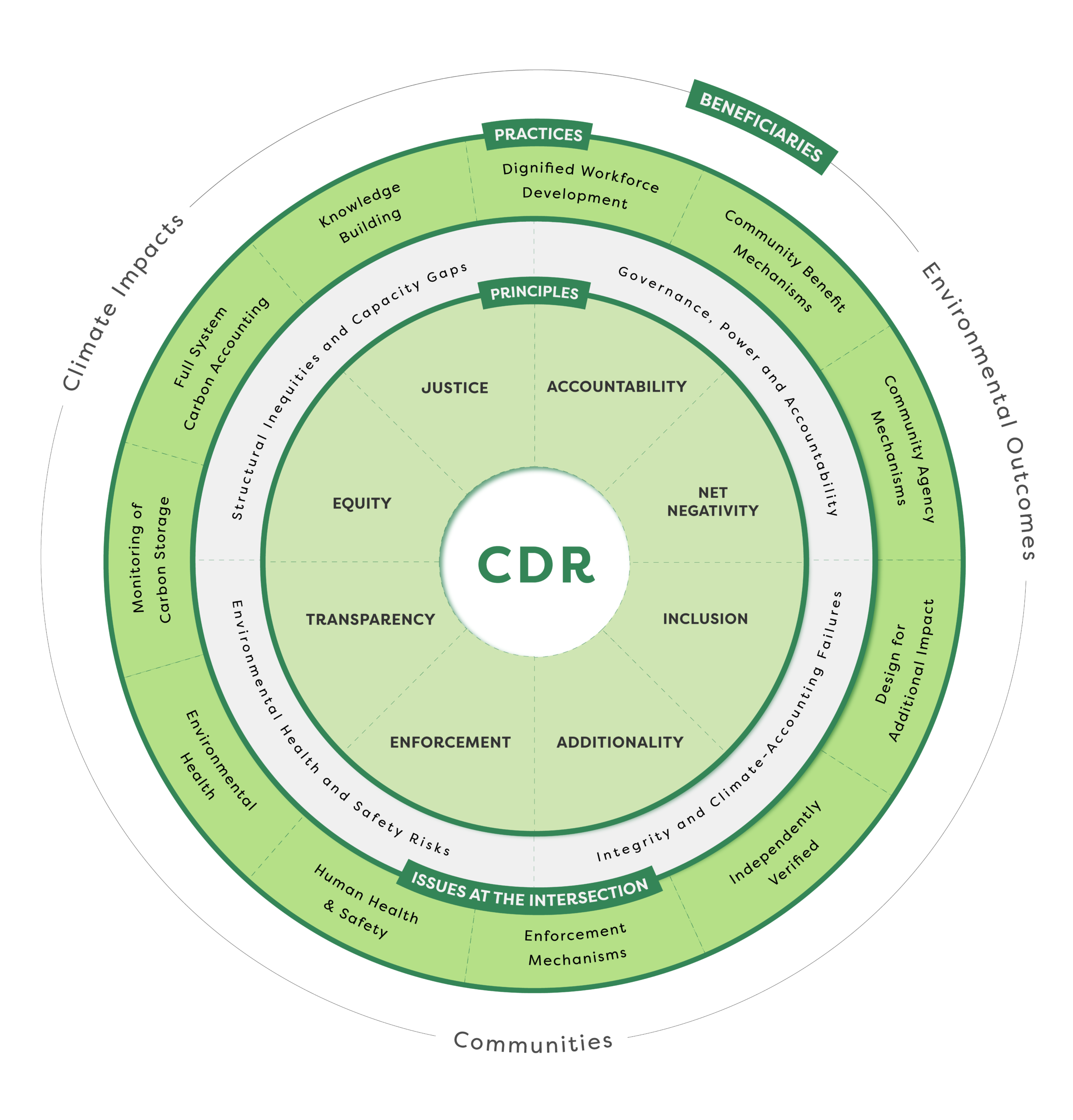
The CORE Wheel
Justice
Existing systems and structures are changed to balance power, address past harms, and create systems to prevent those harms from recurring.
Justice is achieved when all people have access to the same freedoms (freedom from poor air and water quality) and processes (planning and management) without additional support or accommodations because the systemic barriers impeding justice have been removed.
This may be achieved by procedural justice (requiring fairness in the decision-making); distributive justice (equitably sharing resources, risks, and benefits); restorative justice (repairing previous harms); and transformative justice (changing the systems and structures that enabled those harms).
Accountability
Accountability invites examination. This means both maintaining open agendas and decision-making processes,and prioritizing openness when things go wrong. In practice, accountability means acting on criticisms, owning mistakes, and sharing the power over an intervention’s purpose and scope.
Accountability only works if someone is clearly responsible. For each part of this framework, there must be a clearly named actor who has the authority, resources, and systems in place to follow through, including fixing things if they go wrong. Commitments should be made public and binding, and it should always be clear who is accountable for what.
Net negativity
Net negativity means that a carbon removal approach removes more greenhouse gases from the atmosphere than it emits across its full lifecycle. Here, full lifecycle refers to the complete chain of activities and emissions from initiation through the end of the storage period, including ongoing management and monitoring where needed to maintain stored carbon.
True net negativity reflects both the physical outcome — a measurable drawdown of CO2 — and the confidence that this result holds up after counting every stage of the process, from energy and materials to transport and long-term storage. Without it, carbon removal claims have no credible basis.
Inclusion
Inclusion means authentically involving traditionally excluded people and groups in processes, activities, and decision-making in ways that share power. Truly inclusive work bridges the divide between community and intervention governance through efforts like community-driven planning and participatory action research. It must go beyond public comments, fact sheets, and surveys.
Additionality
In carbon removal, climate additionality is the primary test of atmospheric integrity – proof that an intervention genuinely changes CO2 levels beyond what would have occurred under a well-defined baseline scenario that reflects realistic estimates or inferences of carbon fluxes in the absence of the intervention. For interventions that involve crediting, establishing additionality prevents over-crediting and ensures that every ton claimed reflects a genuine climate benefit.
Other forms of additionality help explain how climate benefit becomes possible. Financial additionality asks whether an intervention would have occurred without carbon finance. Regulatory additionality asks whether it goes beyond existing legal requirements. Technological additionality asks whether innovation is expanding what’s achievable. Social additionality highlights the human and institutional shifts that make climate outcomes lasting and just. Taken together, these lenses provide a fuller picture of integrity.
Enforcement
Enforcement means actors comply with laws, policies, directives, and missions while prioritizing and minimizing harms to vulnerable and disadvantaged people. Commitments are not only made but upheld through clear consequences for noncompliance, transparent oversight, and accessible avenues for remedy. In practice, enforcement includes regulations, polluter-pays models, legal aid, and capacity-building partnerships.
Transparency
Parties exchange a robust accounting of all information essential to equitable and informed decision-making. Transparency applies both to how people are engaged and to how information and data are shared. It means that information is not only disclosed but made understandable and accessible to everyone affected. Transparency allows all parties to see how decisions are made, who is responsible, and what impacts occur.
Equity
Equity addresses and alleviates existing unfair treatment and outcomes. Equity is achieved when a person’s life conditions (locally unwanted land use proximity, poor air quality, incarceration) are not predicted by their characteristics (e.g. race, ethnicity, sex, and gender).
Work centering equity acknowledges that some people and groups require more support than others, and creates conditions that close those inequitable gaps without relying on continued external assistance.
-
CORE Wheel purpose
-
How to use
This graphic introduces the CORE Framework at a glance. It helps readers understand what CORE is designed to support, defines the framework’s core principles, and connects these ideas to real-world carbon removal contexts. By visualizing how justice, accountability, and climate integrity work together, it builds a shared foundation for decision-making across the field.
This interactive visual shows how the CORE Framework functions as a connected system.
- CORE’s principles sit at the center as the foundation, that you can click into to explore our working definitions.
- Surrounding them are practices that lead you to case studies — the real-world actions that bring the principles to life and where vested parties engage most directly.
- Between them are the issues that arise where interests, risks, and responsibilities meet, often creating barriers to achieving CORE-aligned carbon removal.
How the framework was developed
CORE was created to help guide decisions while the CDR field is still emerging, before theory becomes deployment, to ensure those most impacted have a meaningful role in shaping the outcomes. The framework was built through an ongoing collaboration that drew on:
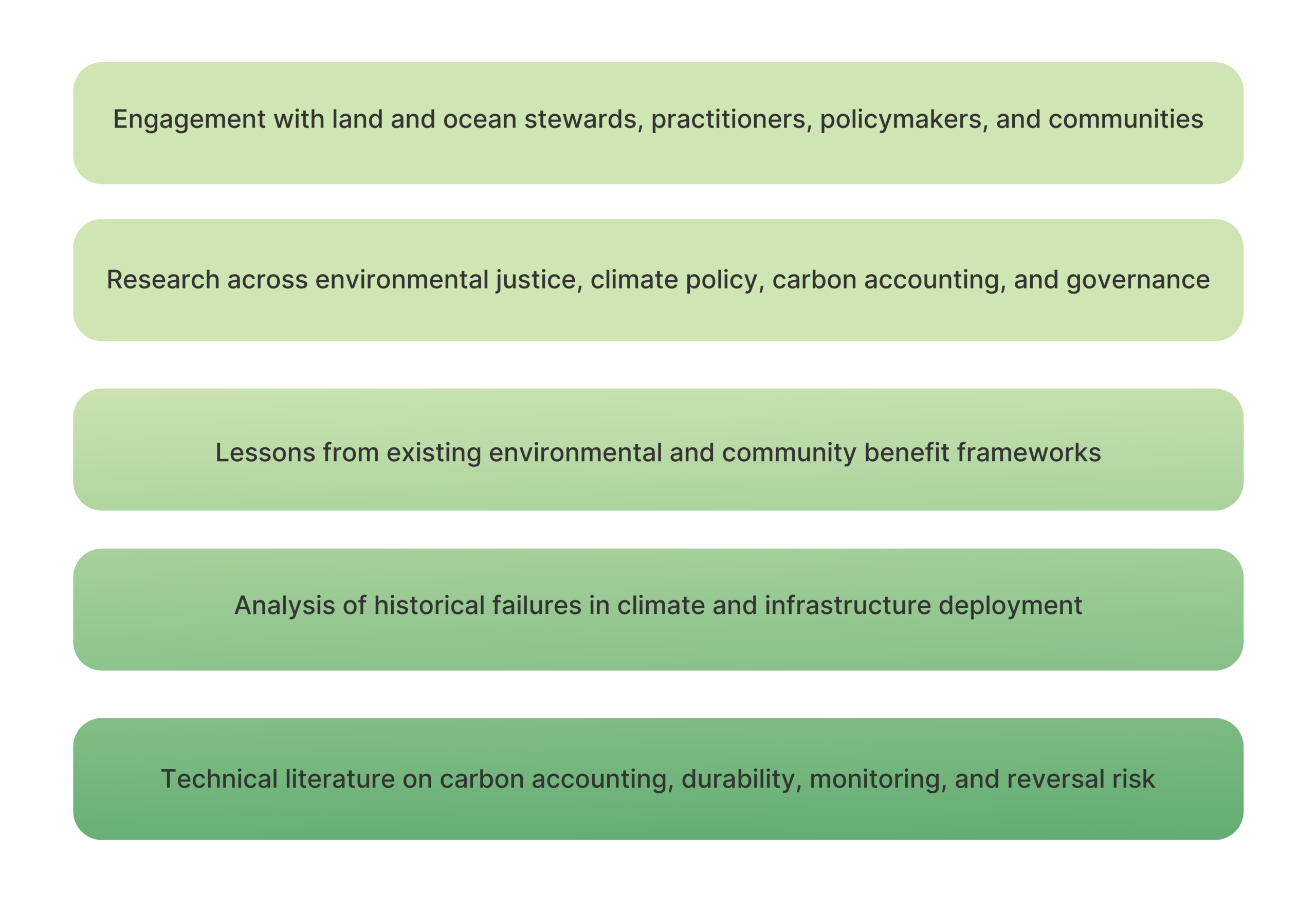
Rather than treating justice, equity, and climate integrity as separate conversations, the CORE framework integrates them. Each principle and practice is designed to respond directly to risks like governance failures, capacity gaps, misaligned incentives, climate accounting weaknesses, and environmental or health burdens.
Want a personalized guide to CORE?
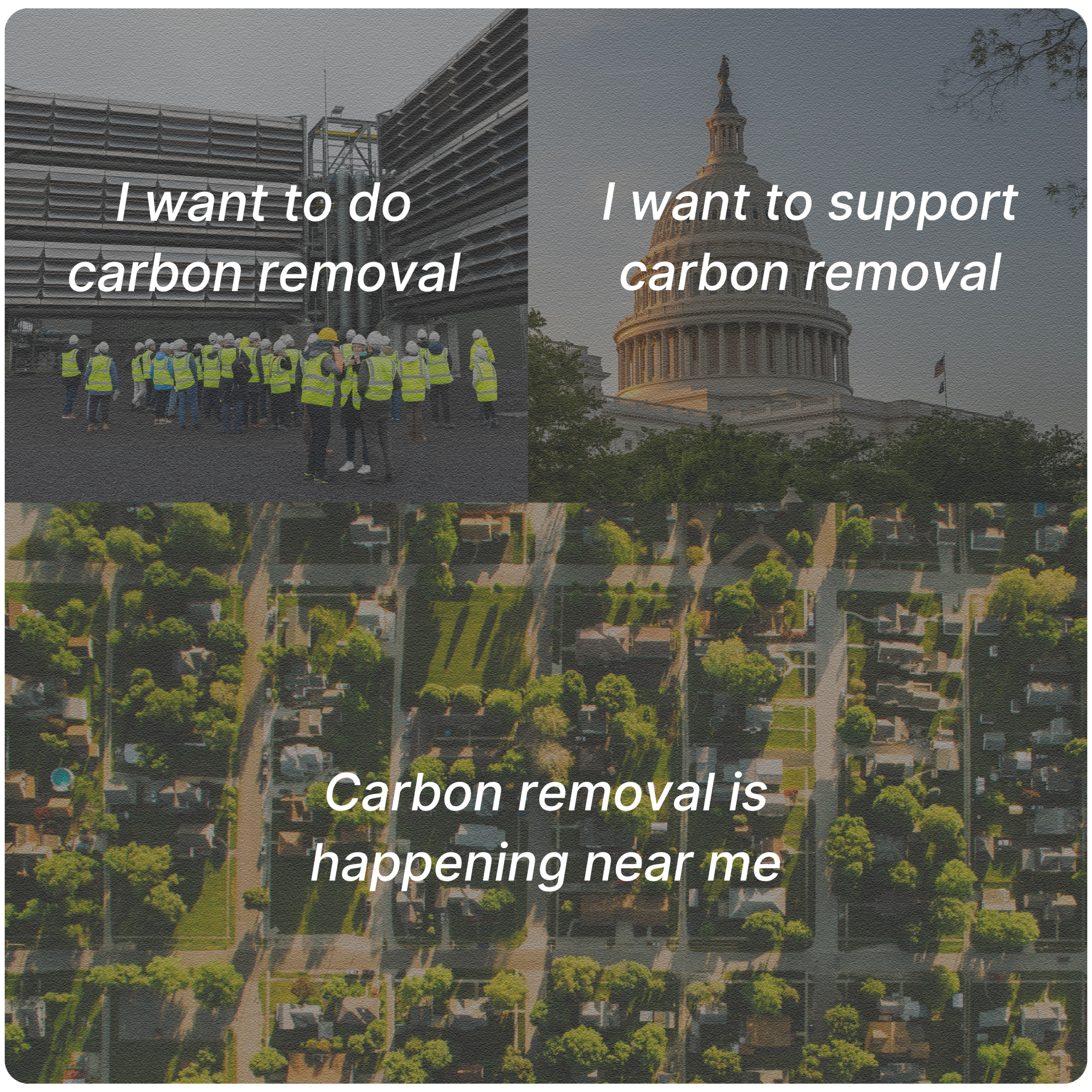
Explore the CORE resource hub
Dive into an interactive collection of tools, examples, and guidance that help put CORE into action. From real-world case studies to practical templates, the hub makes it easier to navigate carbon removal with clarity and confidence. See how to integrate resources in three examples projects:

CORE is a living project

As the carbon removal field matures, so will this framework — guided by science, shaped by lived experience, and accountable to both communities and the climate. We welcome feedback from communities, land and ocean stewards, implementers, policymakers, researchers, funders, and others engaging with this work. Whether you have a suggested edit, a question about implementation, a critique of an assumption, or an example we should consider, we want to hear from you.
All submissions are reviewed on a rolling basis, and we may follow up for clarification where helpful.