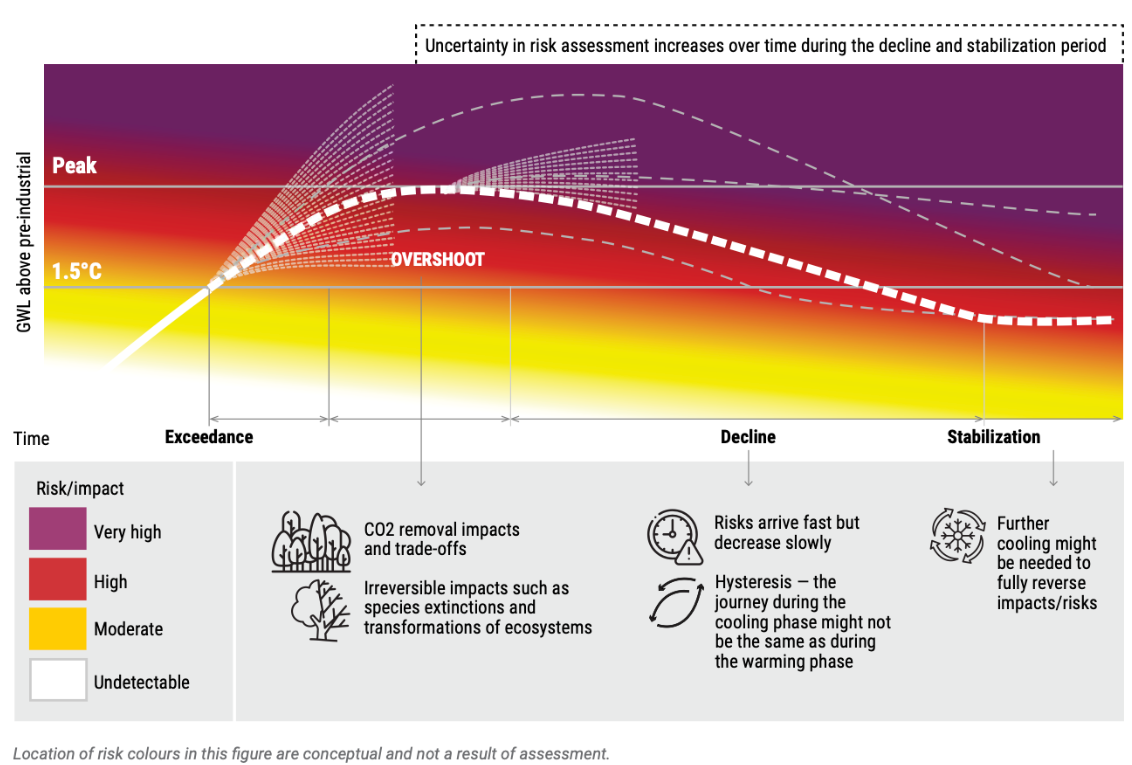
The UNEP just published a lengthy report on Limiting Overshoot – Navigating exceedance of 1.5°C and pathways towards return. That wonky title is the UNEP’s way of confirming that we are unfortunately going to miss our climate goal of limiting warming to 1.5C above pre-industrial average temperatures, and that we’re going to need to do something about it.
The report explores in detail the consequences of “overshoot exceedance” for people and the planet, and how policymakers should adapt their climate policies accordingly. Nine takeaways from the report on what overshoot exceedance means for anyone working on climate change today include:
- Overshoot will happen imminently. It is not a question of if or when overshoot happens, the report is clear that overshoot will happen in the next few years. This means that the operative climate policy challenge we are solving for is no longer “how do we stop emitting in time to avoid overshoot?,” but instead “given that overshoot is happening, how do we respond to it?”
- Overshoot is bad. 1.5C of warming isn’t “safe” or “success” when it comes to climate mitigation –– it’s just better than the very bad risks that emerge with warming further above this level. And overshoot is especially bad for lower income communities in hotter latitudes, meaning it is inherently inequitable from a global justice perspective.
- Every fraction of a degree of overshoot matters. As a result, limiting the magnitude and duration of overshoot is critical.
- We should invest as much as we can in mitigation as quickly as possible. Not that we should throw our hands up in the air because all is lost.
- Mitigation can no longer focus exclusively on emissions reductions in the hope that we don’t need removals down the road.
- Net-zero is no longer the end zone. It is the mid-field line; net-negative emissions is the end zone. Climate policymakers and practitioners across industry and civil society need to adapt their strategies accordingly.
- Carbon removal is challenging. Especially at scale. Especially as the world warms and natural carbon sinks risk turning into carbon sources. Given that carbon removal is necessary, we need to get on with solving these challenges as expeditiously as possible.
- Many carbon removal pathways hold potential; each pathway has its own limitations and uncertainties. If there is a silver bullet for removal, we certainly don’t know what it is yet. The prudent approach to developing removals is thus to pursue a portfolio of pathways, with frequent off-ramps for those that struggle to scale.
- The next decade is critical for removals.
The next decade is crucial for effective and just CDR. Preparing for sustained net-negative emissions requires long-term structural changes in production systems, energy, land use and patterns of demand, supported by sustained investment, innovation and just transitions. Decisions made during the coming decade will shape future technology development, infrastructure and land-use choices, determining whether countries retain the capacity to move beyond net zero if required.
The bottom line takeaway is important: we should go pedal to the medal on emissions reductions while also investing in a fulsome portfolio of carbon removal innovation and commercialization ASAP.