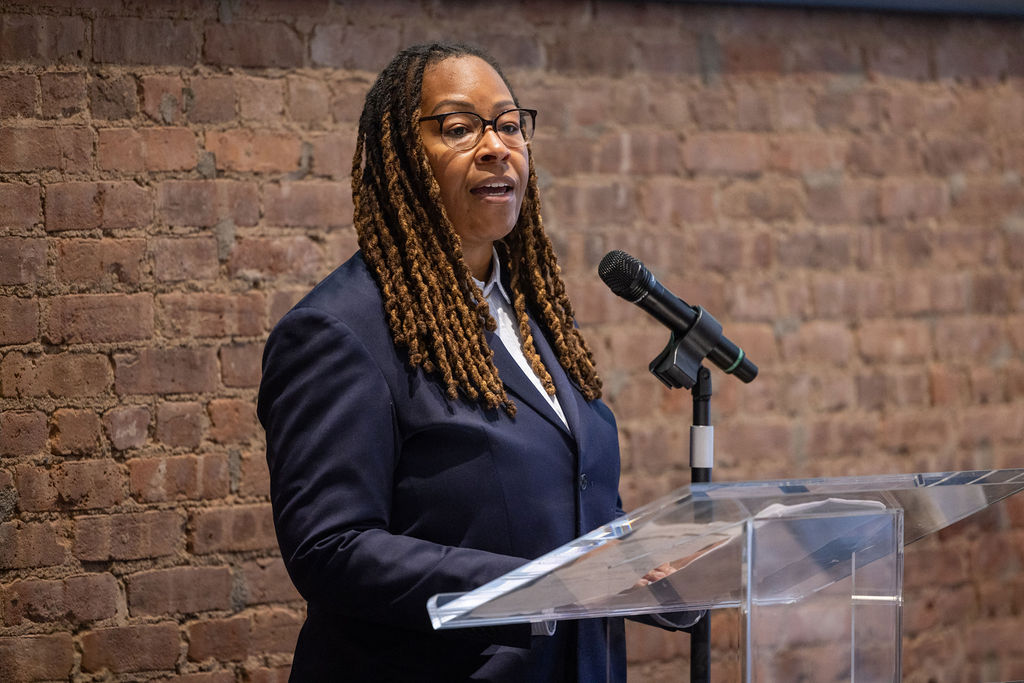
We convened on the unceded ancestral homelands of the Mohican and the Munsee Lenape peoples. I want to begin by acknowledging their enduring relationship to this land and by recognizing that questions of land, power, stewardship, and responsibility are not background issues in climate work. They are central to it.
Our theme for the day was Moving at the Speed of Trust: How to Act Fast on Climate Without Leaving Communities or Ecosystems Behind. That title captures a tension many of us feel every day. The climate crisis demands urgency. The atmosphere is not waiting for a perfect political moment. Communities that are already facing heat, fires, flooding, pollution, and economic disruption can’t wait either. We have to move faster.
But speed by itself is a poor measure of success. A project can move quickly through a financing round and slowly through a community. It can hit a technical milestone and still fail to earn legitimacy. It can count tons while overlooking who carries the risk, who receives the benefits, who has access to the information, and who gets to make the decisions.
This spring and early summer, our team visited our Making Waves regranting partners in Alaska, Hawaiʻi, and Puerto Rico. These are fishermen, Tribal members, cultural practitioners, and restoration teams who know their coastlines firsthand. We didn’t go to ask them to say yes or no to ocean carbon removal. We went to listen, and to learn, what responsible research would have to look like in their waters and on their terms. That takes longer than a conference call. It’s also how trust gets built.
Trust is not the brake on climate action. Trust is infrastructure for durable climate action.
What responsible scale requires
At Carbon180, our mission is to reverse two centuries of carbon emissions. We work to build the people and policy foundation needed to scale carbon removal to gigaton levels. That scale matters because cutting emissions as rapidly and deeply as possible is essential but no longer sufficient. We also need to remove legacy carbon dioxide from the atmosphere and store it responsibly.
The scale of that challenge can feel abstract. Our Road to 2030 policy roadmaps make it concrete: the United States should remove 30 million tons of carbon dioxide annually by 2030. That is a near-term milestone on the path to gigaton scale by midcentury. Today, carbon removal still relies too heavily on pilots, patchwork programs, and a small group of voluntary buyers. We need durable public policy, dependable markets, enabling infrastructure, rigorous standards, and sustained research and development. And we need them across the portfolio.
Carbon removal is not a single machine, ecosystem, or business model. It encompasses approaches on land and in the ocean, in forests and soils, in minerals and biomass, and in engineered systems that capture carbon directly from the air. Each pathway has distinct strengths, limitations, risks, timelines, and relationships to place. Our job is to build the conditions for responsible development to be evaluated honestly, and contribute at a climate-relevant scale, without crowning a single winner too early.
That is why our program that day addressed several questions that are sometimes treated separately: How do we define success? What do coastal communities need to shape emerging ocean approaches? What kinds of capital can carry a project beyond a pilot? What can states and regions do when federal action is uncertain? And how do we build support for multiple pathways without lowering our standards for any of them? These are connected questions. They all ask what responsible scale actually requires.
Carbon180’s CORE Framework gives us a way to hold that question with greater discipline. Or to be even more blunt, the single greatest risk to carbon removal’s success is the loss of public trust, and our CORE Framework is the tool to ensure public trust is centered in the work that we do. CORE stands for Community-Informed, Open Access, Reviewed, and Evaluated. It is a living framework for carbon removal that is just, equitable, and highly accountable. It asks us to integrate justice, accountability, net negativity, inclusion, additionality, enforcement, transparency, and equity rather than treating them as optional add-ons after a project is already designed.
That changes the order of operations. Community engagement cannot begin after major decisions are already made. Transparency cannot mean releasing a technical document that only specialists can understand. Accountability cannot be a promise without a clearly named actor, real authority, resources, and a remedy when something goes wrong. Climate integrity cannot be reduced to a single number if the full lifecycle emissions, environmental effects, durability, and uncertainty are left outside the frame.
Inclusion doesn’t simply mean being invited to provide a comment. It means sharing power in planning, governance, research, monitoring, and decisions about benefits and risks. It means recognizing that community capacity is a form of climate infrastructure and funding it accordingly.
Where we are now
This is especially important now. We are working in a policy environment that has seen progress while also seeing significant instability and uncertainty. Carbon180’s policy tracker shows that federal carbon removal has never been a single program or a single line item. Instead, it is a web of efforts across many agencies. That makes the field resilient in some ways, but it also means that progress depends on implementation, appropriations, coordination, and accountability over many years.
Federal policy still matters enormously. Public investment can fund research the private market will not, establish credible standards, build shared infrastructure, create early demand, and protect the public interest. The lesson is that durable climate governance must be broad enough to withstand political cycles and grounded enough to earn support where projects are implemented.
That durability depends on the less visible work between announcement and outcome. An appropriation is not the same as a functioning program. A pilot award is not the same as a financeable second project. A procurement commitment is not the same as a diverse market. A community benefits plan is not the same as community power. In every case, implementation determines whether a promising policy becomes public value. For carbon removal, that means asking who owns the infrastructure, who carries liability, and who stays accountable years after a ribbon cutting.
States and regions are crucial to that work. So are Tribal governments, local governments, public agencies, researchers, funders, project developers, labor, environmental justice organizations, land and ocean stewards, and the people whose livelihoods are inseparable from the places where climate solutions may be tested or built. If those voices enter only at the end, we should not be surprised when trust is thin. If they help shape the purpose, the evidence, the rules, and the benefits from the beginning, we have a better chance of moving both quickly and well.
Moving at the speed of trust doesn’t mean we’re asking for unanimous agreement. Climate decisions involve real tradeoffs, and responsible people will disagree. Trust means the process is worth participating in. It means information is accessible, uncertainty is acknowledged, concerns can change outcomes, commitments are enforceable, and people know who is responsible. It means we can learn in public and course-correct without pretending that every first answer was the final one.
There is a practical reason to do this. Projects built without trust face delays, conflict, and fragility. Policies developed without affected communities overlook risks and opportunities. Markets without credible measurement lose legitimacy. Investments without durable demand stall after the pilot. Speed that ignores these foundations often has to be repaid later, with interest.
There is also a moral reason. The communities asked to host, enable, or live alongside climate infrastructure should not have to trade their health, livelihoods, culture, or decision-making power for someone else’s climate target. A carbon-removing world should be not only technically feasible but also thriving, equitable, and accountable.
Trust also requires honesty about uncertainty. Across emerging pathways, we are still learning about performance, costs, environmental effects, and the best ways to measure outcomes. Saying so plainly is how credible institutions behave. We can act under uncertainty by setting limits, monitoring impacts, sharing data, funding independent review, and creating real off-ramps when evidence changes. Responsible experimentation means learning alongside the people and ecosystems affected, not pushing the risk onto them.
Three invitations
So, I want to offer three invitations for our conversations, the ones we had in New York and the ones still ahead.
First, be specific about success. When we use terms like scale, benefit, readiness, or community, ask: measured by whom, over what time horizon, and with what consequences? A ton matters. So do public health, ecosystems, jobs, ownership, and a community’s ability to say no or demand a different design.
Second, stay curious about the gaps between sectors. The public sector, private investors, philanthropy, researchers, advocates, journalists, and communities often operate with different clocks, evidence, incentives, and definitions of risk. We make progress by naming those differences plainly and by building structures that enable each actor to do what it is uniquely positioned to do.
Third, treat disagreement as information. The strongest climate solutions come from better questions, transparent evidence, meaningful participation, and a willingness to change course. Listen for where our current systems still ask one group to absorb costs so another can claim progress.
By 2030, we need to be able to point to more carbon removed and to a stronger foundation for everything that comes next: policies that endure, institutions that can implement them, standards the public can trust, a diverse portfolio of pathways, and communities with real power over the decisions that affect them.
That is the work of moving at the speed of trust. It is not slower ambition. It is ambition built to last.
To everyone who spent the day with us in New York, thank you for bringing your experience and your questions, and for being willing to engage candidly.