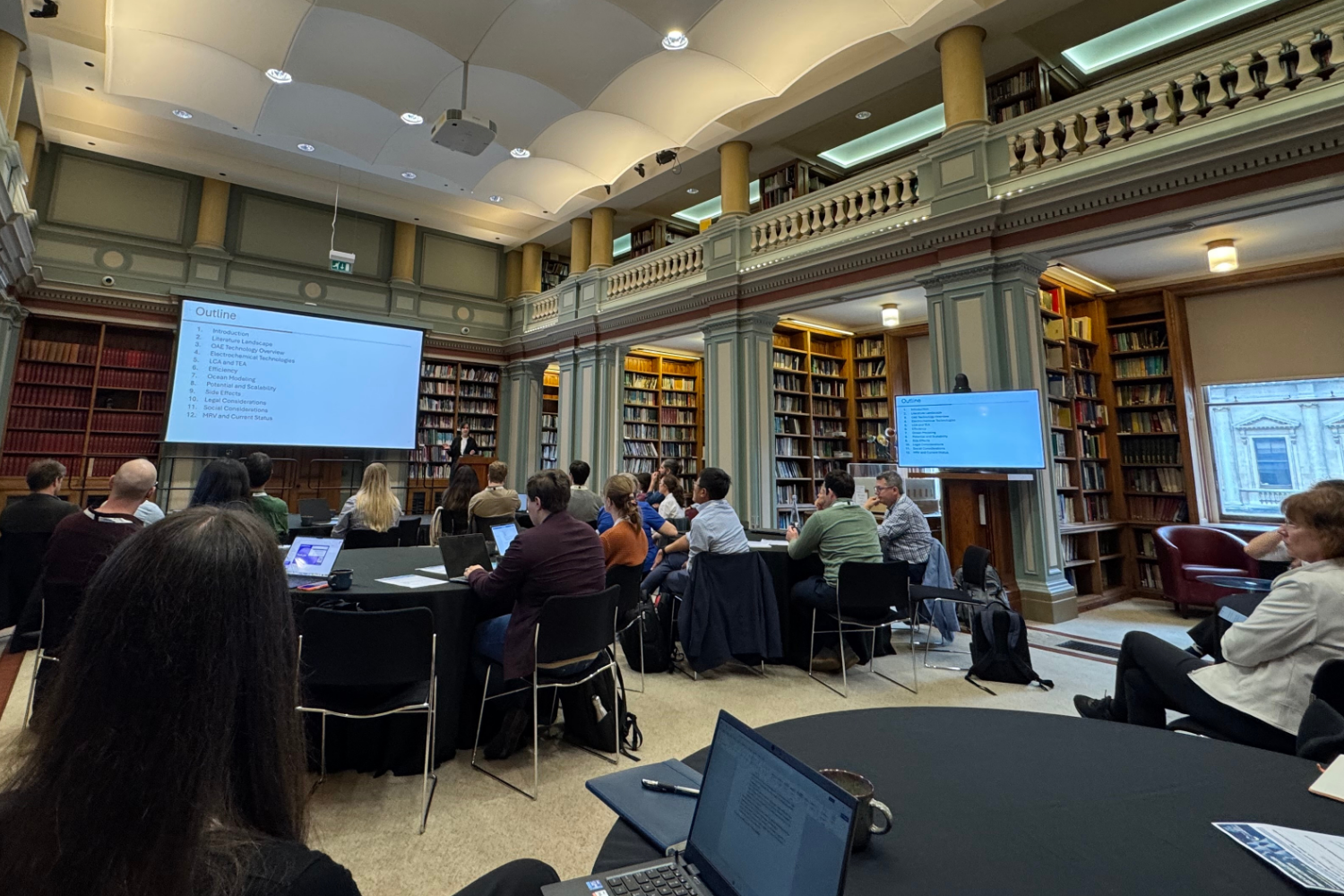
Carbon removal is entering a new phase. As governments, investors, standards bodies, and companies make increasingly consequential decisions about deployment, the need for strong connections between research and decision-makers has never been greater. Over the last couple weeks, Carbon180 joined researchers from across the carbon removal ecosystem in Europe to discuss emerging science, unresolved questions, and the priorities that may shape the field in the years ahead.
So, what happens when Carbon180 sends its two Noahs to Europe for a week of meetings with academics exploring every frontier in carbon removal?
The answer: a lot of coffee, even more questions, and these five takeaways.
1. We need better ways to talk about uncertainty
Carbon removal conversations often collapse many different uncertainties into a single bucket. For example, we often heard that open systems pathways like enhanced rock weathering and ocean alkalinity enhancement “need more research because they are uncertain.”
However, uncertainty about a measurement is not the same as uncertainty about the physical science underpinning a given model. Uncertainty in cost is different from uncertainty in durability. Uncertainty in deployment rates is different from uncertainty in environmental impacts.
These differences matter because they affect how investors and policymakers make decisions. If these stakeholders “look at the science” behind any given solution, the range of estimates for the solution cost, potential, and whether it even works in the first place are so large, that conclusions can be unhelpful and even counterproductive.
Too often, wide ranges are interpreted as disagreement rather than different assumptions. Upper-bound estimates receive outsized attention. As carbon removal enters the mainstream, uncertainty is increasingly used to support very different conclusions. For some, uncertainty becomes a justification for confidence that a pathway will eventually achieve its most optimistic projections. For others, the same uncertainty becomes a reason to delay action until much stronger evidence emerges or dismiss a pathway entirely. We can’t eliminate all uncertainty, but we can become more transparent about what we know, what we don’t, and what decisions can reasonably be made based on the knowledge we have today.
2. The field needs a better theory of “good enough”
Building on uncertainty: climate timelines don’t allow us to wait for perfect certainty. At the same time, premature deployment can create environmental risks, undermine public trust, and divert resources from more promising approaches.
This raises an uncomfortable but important question: Which uncertainties must be resolved before deployment, and which can only be reduced through deployment? And how do we enable deployment to move fast while not turning into a runaway train if unexpected negative impacts arise as a given field scales?
More broadly: What does “good enough” look like at different stages of development? What evidence is required before pilots? Before demonstrations? Before procurement? Before compliance markets? And critically, who gets to decide what is good enough?
Carbon removal may benefit from a more explicit theory of stage-gated development: one that focuses resources on the interventions most likely to succeed without stifling early-stage innovation. This question sits at the uncomfortable intersection of science, values, and decision-making. Academics have an essential role to play, because they understand the nature of the uncertainty itself: which questions are settled, which remain open, and what risks are truly being traded off at each stage of development. Without that perspective, it becomes much harder for policymakers, investors, philanthropists, and standards bodies to design stage gates that appropriately balance innovation, rigor, and risk.
3. We Need Long-Term Field Trials for Open-System Carbon Removal
Some of the most important scientific questions cannot be answered in laboratories. This is particularly true for open-system approaches like enhanced rock weathering, ocean alkalinity enhancement, biochar, soil carbon sequestration, and potentially other marine approaches.
These interventions interact with complex environmental systems over long timescales. Their performance depends on climate, geography, feedstock, management practices, and local ecosystems.
The field increasingly needs longitudinal studies across diverse geographies and climates using multiple feedstocks and deployment approaches. And those studies need standardized measurements and to produce publicly available datasets.
This is not just to understand carbon removal rates, but also to understand ecosystem impacts, agricultural outcomes, regional variability, and net climate benefits.
The questions we need to answer are increasingly clear, but the harder question is how we define and fund the infrastructure required to answer them.
4. Biomass usage will be a resource allocation issue
Competing climate solutions are making increasingly overlapping claims on scarce biomass resources — the limited supply of plant and organic materials that many climate and industrial solutions compete to use. Biochar, BECCS, sustainable aviation fuel, biofuels, bio-based products, industrial heat, and other BiCRS approaches all can compete for the same feedstocks.
But most analyses on the bioeconomy today focus on how much biomass exists. Not many ask how we should use that biomass to optimize for climate, energy, food, water, and other societal goals –– let alone do this in a spatially resolved manner. Biomass itself is a resource allocation problem. Answering how we allocate biomass will require spatially resolved analyses that account for resource availability, climate outcomes, infrastructure constraints, alternative uses, and regional economics.
Because ultimately, every tonne of biomass can only be used once, and as deployment scales, these tradeoffs will become harder to ignore.
5. Carbon removal needs better transparency and failure infrastructure
A growing share of carbon removal innovation is happening inside private companies rather than academia. This has accelerated development.
However, it also creates a challenge as negative results will remain private. Failed projects disappear without documentation; data sharing is limited; and when companies pivot, fail, or are acquired, years of institutional knowledge can disappear with them. Without better mechanisms for information sharing, the field will continue to pay to learn the same lessons from failed projects.
If carbon removal is serious about learning-by-doing, it needs systems that preserve learning from both successes and failures. It forces us to ask questions around what information should remain proprietary and what information should become shared infrastructure?
Could shared testing facilities help? Public-private partnerships? Data-sharing requirements tied to public funding? Industry-wide learning systems?
These aren’t easy questions, but they may ultimately determine how quickly the field applies lessons from early-stage projects.
What does this mean?
Many of the problems facing carbon removal are questions about learning, prioritization, evidence, and how institutions will make decisions under uncertainty.
While scientists are not directly responsible for making policy and investment decisions, their work increasingly informs those decisions. Communicating to these audiences in addition to other academics helps avoid a game of telephone, and ensures work is accurately represented and maximally impactful in our endeavors to scale carbon removal.
Similarly, policymakers and investors should recognize that there is now a robust academic community working on basically every aspect of carbon removal. Engaging with these researchers directly is extremely valuable to ensure that their work is interpreted correctly, identify gaps in knowledge, and help ground policies and investments in the strongest science available.