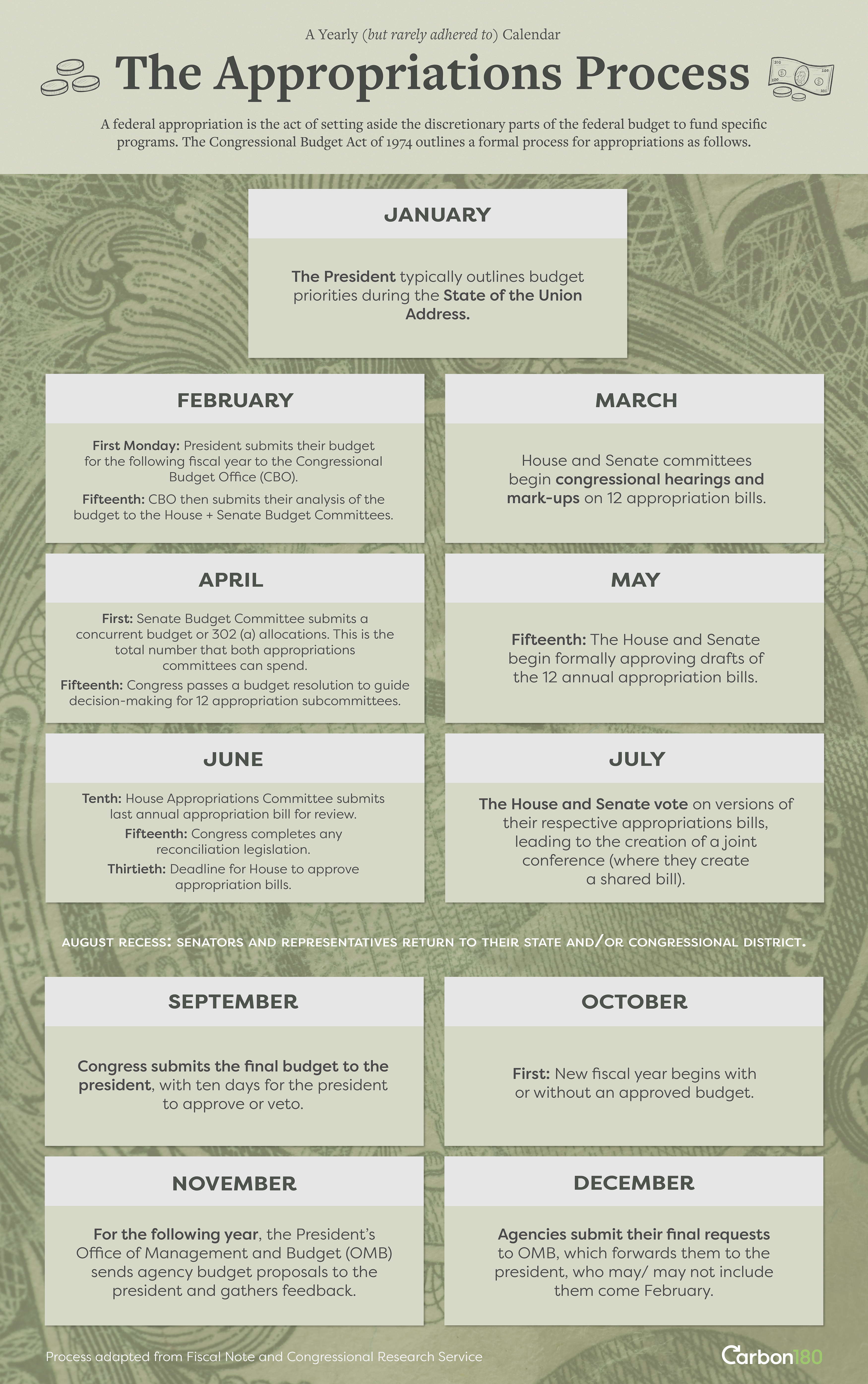
The process for formalizing the Department of Energy’s (DOE) FY2027 budget through annual appropriations has begun. On Wednesday of this week, the House Appropriations Committee passed its Energy and Water Development bill, which allocates funding for programs at DOE, among others. While there is a long way to go before it reaches the President’s desk for final approval, it’s worth exploring how this initial proposal reflects the energy policy priorities of the current House majority.
Reorganization at DOE
The bill provides $700 million for the Hydrocarbons and Geothermal Office (HGEO), formerly known as the Fossil Energy and Carbon Management (FECM) Office, which houses most of DOE’s carbon management activities. The final funding levels for FECM in last year’s budget were slightly higher at $720 million. As a consequence of DOE’s recent reorganization, HGEO now encompasses geothermal programs, which the bill proposes to fund at $150 million. Given this programmatic shift, the $700 million funding recommendation for HGEO represents a deeper cut to carbon management than a topline comparison might suggest. Below are the proposed funding amounts for programs relevant to carbon removal and the percentage of reduction compared to last year’s budget, per the Bill Report:
- Carbon Dioxide Removal, $15 million, 67% cut from enacted FY2026 level
- Carbon Utilization, $35 million, 30% cut
- Carbon Transport and Storage, $50 million, 15% cut
- Point Source Capture, $50 million, 33% cut
Unfortunately, these aren’t the only potential reductions in funding that jeopardize progress in carbon removal.
Redirecting IIJA investments
Even more concerning is the House bill’s proposal to reprogram roughly $2.8 billion provided by the Infrastructure Investment and Jobs Act (IIJA), from offices and programs seeking to advance carbon management priorities including:
- $1.15 billion from the Office of Fossil Energy and Carbon Management;
- $591 million from the Office of Energy Efficiency and Renewable Energy;
- $439 million from the Office of Clean Energy Demonstrations; and
- $595 million from the Carbon Dioxide Transportation Infrastructure Finance and Innovation (CIFIA) Program Account.
By providing DOE with the discretion to shift money away from these accounts, the bill jeopardizes continued support for relevant carbon removal programs such as the Direct Air Capture Hubs (IIJA 40308), Carbon Utilization Procurement & Research (IIJA 40302), CO2 Transport FEED Studies (IIJA 40303), CarbonSAFE (IIJA 40305), and Direct Air Capture prizes (IIJA 41005). The bill’s proposed reprogramming of CIFIA funding effectively eliminates the program, which provides necessary federal support to build infrastructure related to carbon transport and storage.
What’s next
We need to invest more in the research, development, demonstration, and deployment of carbon removal technologies and enabling infrastructure, rather than gut the modest but crucial funding available. Without sufficient federal support, US developers will lose their competitive advantage to global competitors and fall behind in the race to commercialization. Despite this bill’s proposal to roll back funding, we’re cautiously optimistic as attention turns to the Senate. Last year, a bipartisan group of Senate lawmakers allocated up to $116.5 million at DOE to advance carbon removal development and deployment, compared to $15 million in the House bill. We’ll be keeping a close eye on further budget developments as the process continues, including the releases of House report language and the Senate’s version of the Energy and Water Development bill.
Edited by Ana Little-Saña. Photo by Darren Halstead.