Carbon180 uses the term carbon dioxide removal (CDR) to describe all the ways in which carbon dioxide can be removed from the atmosphere. While CDR often evokes imagery of large industrial facilities powered by complex scientific processes, carbon removal also encompasses natural processes. CDR is actually everywhere, from the ground beneath your feet to the trees in communities that absorb carbon from the atmosphere.
Land-based carbon removal comes with real challenges. For one, many of the benefits of natural processes can’t be quantified in terms of tons removed or other metrics set by policymakers or the voluntary carbon market. There are also dozens of pathways, each with different carbon storage permanence and potential. There are also remarkable opportunities for land-based CDR, including numerous co-benefits for producers, land stewards, and communities.
Below are some of the most commonly asked questions about land-based CDR and the pathways that fall under it. Understanding how these natural pathways function differently from technological or ocean-based approaches helps clarify where they fit into the broader portfolio of solutions needed to help us meet our climate goals.
Q: What is land-based carbon removal? What pathways fall under this category?
Land-based carbon removal draws carbon dioxide from the atmosphere through natural biological and biogeochemical processes, primarily photosynthesis, and storing it within the biogenic carbon cycle. This includes pathways that enhance carbon uptake across natural and working landscapes, with storage in soils and living biomass on croplands, rangelands, forestlands, and wetlands — often referred to as natural climate solutions.
As new CDR pathways emerge, this definition has expanded to include approaches that begin with biological feedstocks, such as biochar or enhanced rock weathering. For these pathways, industrial processes accelerate removal or increase storage durability. Carbon180 classifies these pathways as part of land-based CDR within a ‘hybrid’ subcategory, combining both biogenic and engineered carbon removal to extend carbon storage duration.
| Pathway | Description | Type of storage |
|---|---|---|
| Afforestation | Planting trees to establish a forest on land where a forest has never existed or has been absent for a long time (at least 50 years). | Aboveground and belowground biomass; soils |
| Reforestation | Supporting restoration of a forest ecosystem on land where a recent forest existed and was lost to uncharacteristic wildfire, pest and disease, clearcutting, or non-forest land use. Includes tree planting, stand management, pest and disease management, managing for natural regeneration, and other sustainable management practices for recently restored forests. | Aboveground and belowground biomass; soils |
| Sustainable forest management | Managing forests for near-term and long-term health, including via enrichment planting, release of natural regeneration via management of competing vegetation, stand irrigation and/or fertilization, reducing timber harvest levels. | Aboveground and belowground biomass; soils |
| Agroforestry | The intentional integration of trees or shrubs into productive agricultural systems, including silvopasture (trees in pasture), riparian buffers, windbreaks, shelterbelts, alley cropping, and forest farming. | Aboveground and belowground biomass; soils |
| Sustainable agricultural land management | A system of agricultural land management that works to satisfy human food and fiber needs while enhancing environmental quality and the natural resource base. Core practices include cover crops, perennial cover (grains, forages), no till/low till, polyculture and crop rotations, soil building amendments (compost, microbiota, organic waste). | Soils |
| Sustainable grassland management | Assisted protection, conservation, management, and restoration of grassland landscapes. Practices include perennial grains, perennial forages, management-intensive rotational grazing, prescribed burns, and overall grassland restoration. | Soils |
| Wetland restoration | Assisted protection, restoration, and on occasion expansion of inland ecosystems permanently or seasonally saturated by water (e.g. peatlands, swamps, bogs) and of coastal ecosystems (e.g. tidal marshes, mangroves, seagrass meadows). | Aboveground and belowground biomass; soils |
| Biochar | Pyrolysis of biomass with high carbon content sourced from various feedstocks including waste residues from agriculture, forests, and wood processing, or crops grown specifically for biochar., | Biochar in soils |
| Biomass burial (hybrid pathway) | Burying woody biomass underground in special containers or “vaults” to slow or prevent wood decay (e.g. tree trimmings, harvest residues). Sometimes wood is buried after being combusted for other purposes. | Geological sequestration |
| Durable wood products (hybrid pathway) | Use of wood-based materials in durable long-lived products typically used in construction (e.g. including sawnwood, wood panels, and composite beams). | Wood-based carbon |
| Enhanced rock weathering (hybrid pathway) | Application of crushed silicate minerals to agricultural lands or coastal environments to mineralize with carbon dioxide in the ambient air, both to increase carbon stored in soils and to run off into rivers, streams, and local waterways before being deposited for long-term storage in the ocean. | Ocean alkalinity or soil carbonates |
Q: How does soil store carbon? How much can it store and for how long?
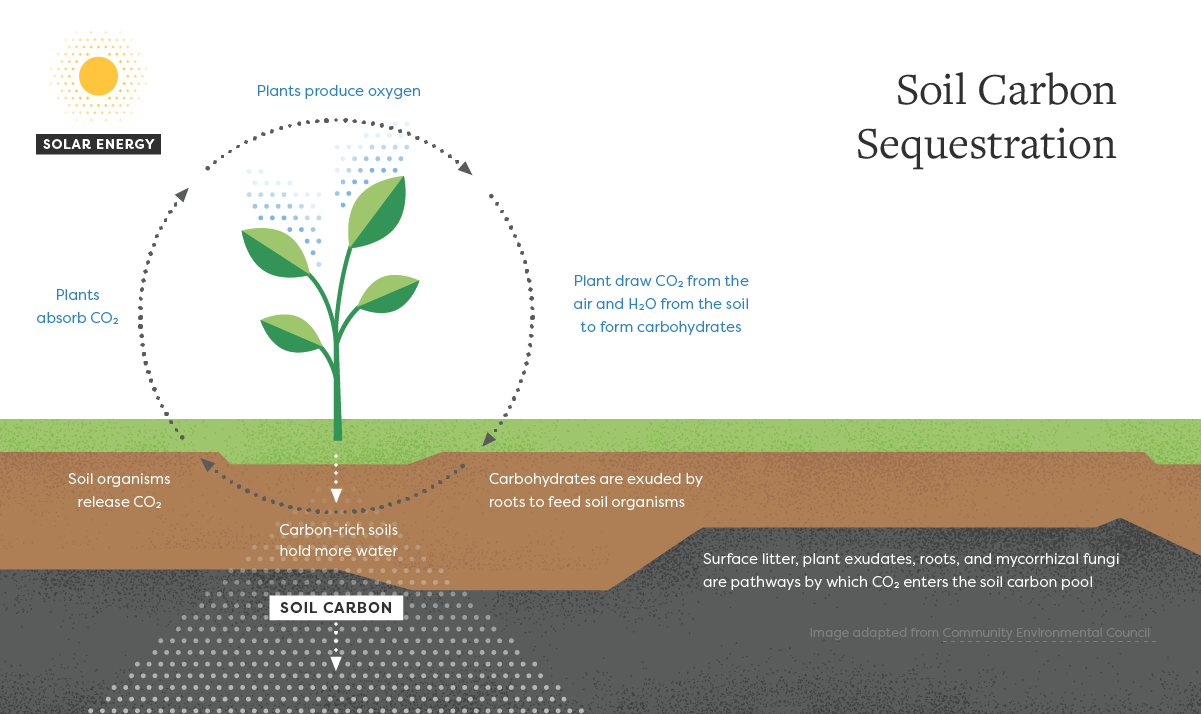
Plants capture carbon dioxide through photosynthesis, storing it aboveground in plant biomass or belowground in soils. Carbon enters the soil through plant roots, where it feeds diverse microbial communities. These organisms process and store carbon primarily as soil organic carbon (SOC), while releasing some residual CO₂ back into the atmosphere.
Soil carbon storage capacity varies widely by climate, land type, and land use history. All soils have natural saturation points beyond which they cannot store additional carbon. Although a significant soil carbon debt remains, some soils are much closer to saturation than others. Conventional land-based CDR pathways typically store carbon for years to decades, not centuries. Hybrid pathways like biochar can extend that carbon storage timeline significantly. That means sustained investment in policies and practices is essential to keeping carbon in the ground over time.
Q: What is soil carbon debt? How does it relate to CDR?
Think of soils as a bank for carbon storage. Practices that sequester carbon — such as perennial crops or continuous ground cover — make deposits, while those that disturb soil and degrade biodiversity drive withdrawals. Over the last 12,000 years of agriculture, especially the past two centuries of industrial intensification, an estimated 133 billion metric tons of carbon have been lost from the top two meters of global soils, leaving the planet in deep soil carbon debt.
Land-based CDR seeks to reverse this trend by investing in practices that rebuild soil carbon, removing it from the atmosphere and storing it underground. Yet, US policy still largely incentivizes extractive land use, accelerating the conversion and degradation of forests, wetlands, grasslands, and croplands. At the same time, growing disturbances from wildfire and drought are compounding those losses. Reversing this will take landscape-scale changes in land management, backed by policies that restore soils as carbon sinks while prioritizing community and ecosystem health.
Q: What are the benefits and risks associated with land-based carbon CDR?
Land-based CDR delivers a wide range of benefits for people and the planet, with many pathways that are shovel-ready and relatively low-cost compared to other CDR interventions. Practices that store carbon often also strengthen ecosystems, reducing soil erosion, increasing biodiversity, and enhancing water filtration and retention. They can also generate economic and cultural value, including jobs, food sovereignty, and recreation. Often, these non-carbon benefits are what communities and land stewards prize above all, with carbon storage as an added plus. Policy solutions must center ecosystems, communities, and land stewards — not just carbon — to fully realize the potential of land-based carbon sinks.
The benefits and risks of land-based CDR programs depend heavily on context. While generally lower-risk than other CDR approaches, outcomes hinge on implementation. Many land-based pathways have relatively low durability, requiring sustained management to keep carbon stored in soils and biomass. Programs focused only on carbon risk reinforce existing harms, such as reduced ecosystem resilience, biodiversity loss, land tenure insecurity, and economic displacement.
Hybrid pathways introduce additional opportunities and uncertainties. Many require further research, especially field testing in real-world settings such as farms and forests. While they can offer longer-term carbon storage than conventional approaches, they also carry distinct risks, and require further evaluation to ensure safety and effectiveness.
Q: Can land-based carbon CDR offset greenhouse gas emissions?
Most greenhouse gas emissions come from fossil fuels — carbon drawn from the Earth’s slow carbon cycle that took millions of years to form. By contrast, most land-based CDR operates within the biogenic carbon cycle, which involves much faster exchanges between the atmosphere and living systems. Using short-lived land-based carbon storage to offset long-lived fossil emissions creates a mismatch that risks overstating climate impact.
Instead, land-based CDR with durability on the order of years to decades (rather than centuries or millennia) is better understood as restoring natural carbon sinks and repaying soil carbon debt, not as offsetting fossil emissions. Hybrid pathways like biochar may offer longer-lasting storage that better aligns with fossil carbon timelines, but they require further research and development before they can scale reliably.
Q: How can policy support land-based CDR? What are some opportunities to expand land-based CDR?
Policy plays a central role in scaling land-based CDR across US agriculture and grasslands, forestlands, wetlands, and hybrid pathways. Many of these practices have been stewarded by communities, particularly Indigenous communities, for millennia. Yet federal policy still largely incentivizes extractive land use that depletes carbon sinks.
Carbon180 advocates for stronger policy frameworks that enable just, equitable, and accountable carbon removal. This includes improving underlying conditions, often through sector-specific levers, to deliver carbon benefits alongside ecological and social outcomes. Land-based CDR policy should also expand access to financial incentives and technical assistance for land stewards, and strengthen carbon measurement and monitoring.
The next Farm Bill should prioritize two key pillars: investing in research and expanding access for land stewards. To better understand the benefits of land CDR, federal research should improve monitoring, reporting, and verification (MRV) by standardizing soil carbon measurements and shifting forest management metrics toward outcome-based indicators. By focusing on implementation, federal support could help ensure that farmers, ranchers, and foresters can put this science into practice by expanding access to federal programs. Together, these priorities aim to translate research into real-world impact, building more resilient agricultural and forestry systems while advancing climate goals. The bottom line: the science exists and the practices work. What’s missing is the federal commitment to the policy tools that are available.
Photo by Courtney Fee. Edited by Ana Little-Saña.