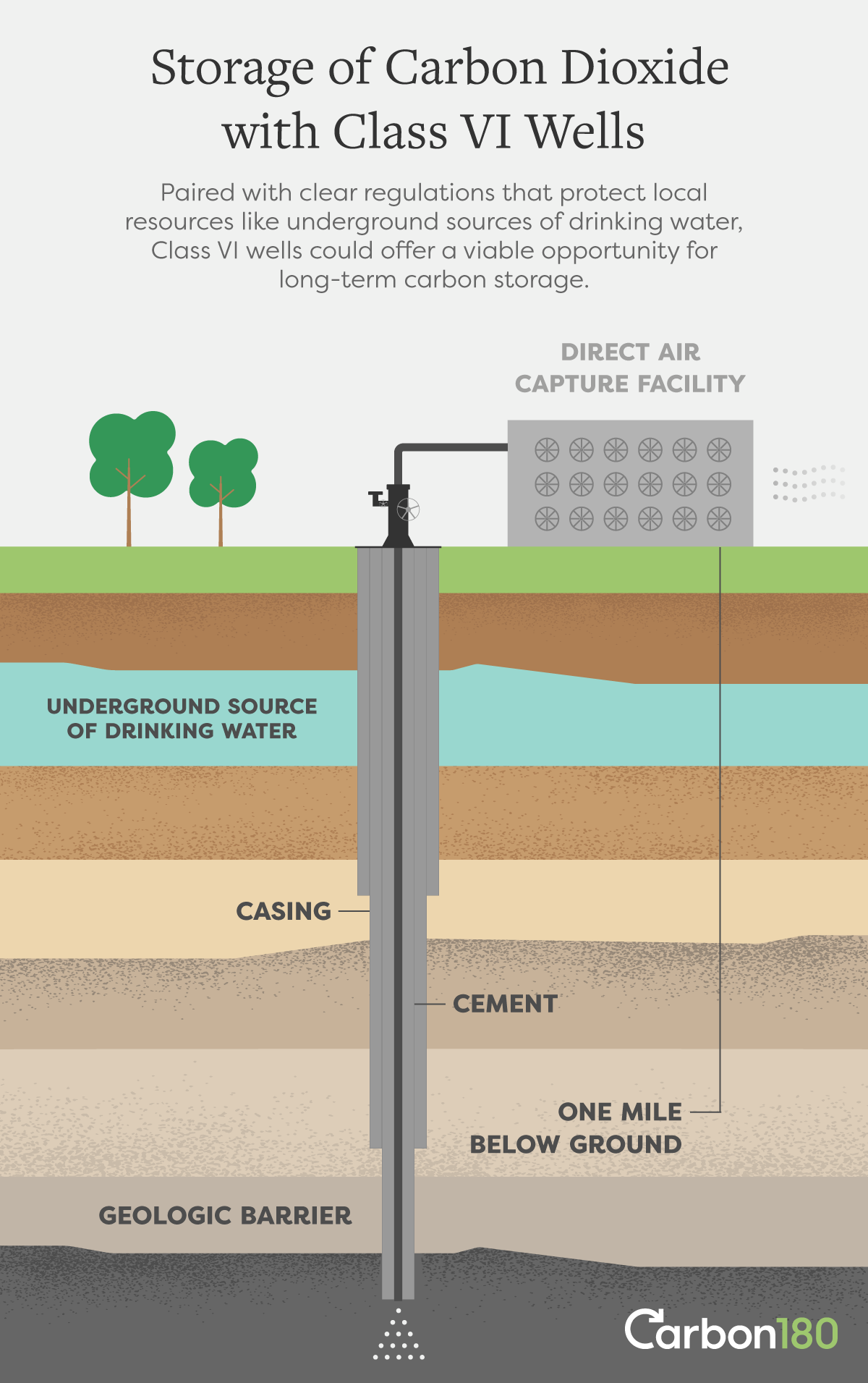
In January, Indiana announced it would be seeking primacy over underground carbon dioxide storage, replacing EPA’s default oversight. Primacy allows states to set their own laws for how Class VI wells (the geological storage site for captured carbon dioxide) will be approved, constructed, monitored, and sealed. Six states hold or are close to primacy already, while Indiana joins Colorado and Alaska in drafting their rules.
So if you’re a resident of one of those states, what questions should you be asking yourself and your state legislature?
1. How does giving the state primacy change who protects my water and my health?
Primacy is a hand-off, from the EPA to a state regulatory agency. So it’s a good idea to get to know who will be taking responsibility for these decisions! In Wyoming, West Virginia, Arizona, and Louisiana, an environmental or natural resource department has taken on this role, while in New Mexico the work is led by the Oil Conservation Division and in Texas by the Railroad Commission. Understanding who will be evaluating each permit’s safety gives citizens an early expectation of the capacity, philosophy, and accountability of their state’s permitting agency.
Ask your state who will manage primacy and how they will ensure they have appropriate staffing levels, technical qualifications, and public accountability standards.
2. How and when will I be informed about projects in my area? And how will my feedback be used?
The EPA sets a high standard for public notification. By statute, once they begin reviewing a permit they must notify local media, any people or groups who have requested to be kept informed, and offer thirty days or more of lead time as appropriate to allow public response. All significant comments must be considered, briefly described, and addressed in the final decision, and become part of the administrative record. They also have guidance recommending that developers begin public meetings and hearings as soon as possible, and that they create a communication plan to identify the best methods for reaching stakeholders around the site.
In contrast, state agencies have significant discretion over public notice requirements. North Dakota, for instance, notifies only landowners within a half mile of the project borders. Public hearings are announced only in the affected counties local newspaper, and with only 14 days lead time. This will allow very little opportunity for civil society feedback. Texas and Arizona have made the recommended public hearing optional – the state agency director gets to decide if there has been sufficient public interest to merit a hearing.
Advocates should ask for mandatory public engagement requirements. These should give at least 30 days of notice, have performance based metrics that ensure community members are being reached, notify beyond immediate landowners, and clearly explain how public input will be responded to.
3. What protections exist for environmental justice communities under state programs?
The EPA has written extensive guidance about environmental justice considerations for these projects, from reviewing community vulnerabilities before approving sites to ensuring outreach is accessible to all participants. However, there are no statutory requirements in place, meaning that administrators have no obligation for any kind of justice-informed review.
This is one place where states have the opportunity to go further, recognizing vulnerabilities and protecting citizens. Texas has made a first gesture in this direction, requiring applicants to identify environmental justice and limited English-speaking households as part of their application. These include multi-lingual public meeting notices and comment forms, paying for interpreters, accepting multi-lingual public comments, and positioning meeting venues near public transit.
Advocates should build locally-relevant protections into statute requirements. These might include accessibility and language requirements, EJ screening tools, mitigation or community benefit sharing requirements. Regulators should be given explicit authority to deny or condition permits based on community impacts.
4. What are permits designed to protect?
At its core, EPA’s right to oversee underground carbon injection is based on its protection of drinking water. Well safety is viewed through the lens of ensuring the gas cannot move into groundwater. The office isn’t expected to hold developers accountable for any environmental impacts beyond drinking water resources.
This creates an opportunity and a vulnerability for states. Most state regulations list a duty to mitigate harms to the environment, but without guidance on how much harm is too much. This gives little legal leverage to advocates concerned by the potential for rare but potentially catastrophic events or by indirect harms caused through CO₂ transportation and storage.
States may choose to expand environmental requirements to include monitoring for seismicity or mitigating any re-release of CO₂. They could require investment in community-level monitoring programs or local emergency responder training and capacity. They could pair permits with safety standards for paired pipelines or other transport options.
5. Who is responsible if problems show up decades later, after the site is closed?
Under federal rules, the permit holder is liable for any problems with the well, even after the site has been closed. In contrast, in North Dakota and Wyoming, the state takes over ownership and liability for stored carbon dioxide. Injectors pay into a state fund for this purpose.
It is unclear who would be legally or financially accountable if problems were found after site closure. This could pose an issue because, where the EPA and most states default to fifty years of monitoring post-injection, monitoring is only required for twenty years after injection stops in Wyoming and for ten years in North Dakota. Even where fifty years is required, in many states operators can petition to reduce the monitoring window.
Advocates should push for clear legal liability that ensures early closure cannot insulate operators against damages if carbon dioxide migrates or escapes storage. Post-closure monitoring requirements should reflect known geological risk and extend for at least twenty years following injection with a preference for fifty.
Edited by Jason Aul. Cover image: Edwin Andrade